Sunday, November 24, 2019

Appraisal-Emotion Theory


The scene when Serena makes June take a pregnancy test is a less than ideal way to find for June to find out she is pregnant. When Serena storms into June's room and shouts "You could have left me with something" and hits June so hard her head hits the ground and she begins to bleed. June is stunned by Serena's rage. Serena then orders June to take a pregnancy test right then and there. Serena looks at the test and with a smile on her face says "praise be his mercy," implying the test was positive. Serena then goes on to thank the lord for answering 'their' prayers. June's first appraisal emotion is anger, and replies to Serena, "you think I prayed for this?" Junes action of the appraisal is to shake her head. After a few seconds, June begins breathing heavy and is in full disgust looking at Serena's joy filled face. June feels anger and disgust with this news and responds to her emotion with 'smart' remakes towards Serena. 

‘You think I prayed for this?’ Offred reels from the positive pregnancy test.

Basic Emotions


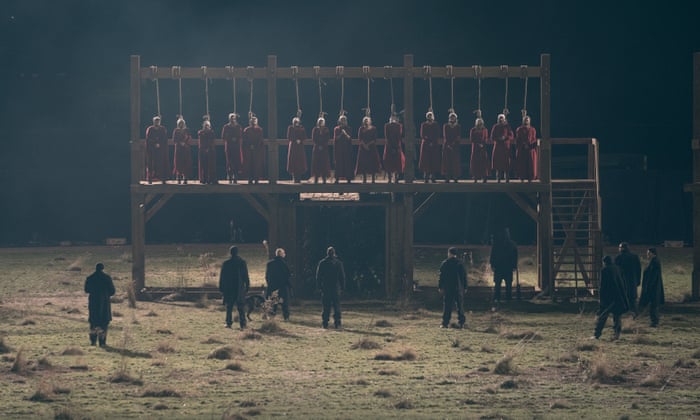
I will say that every episode of The Handmaid's Tale is FULL of emotions, for June and viewers. One scene that encompassed multiple strong emotions was the 'fake execution scene' of all the handmaid's. It was crazy. 

After the handmaid's refused to stone Janine, a handmaid from Offred's district who had her eye removed for lack of obedience, the handmaid's were rounded up like cattle and were threatened, beaten, and herded into an old baseball stadium, when they realize what is about to take place. 


As they are physically pushed into a hasty walk, they see, standing in front of them, a wooden platform with nooses. All at once, the handmaid's hands are bound in rope and their mouths are covered with leather. All of the women are seen trembling in fear, tears streaming down, eyes wide open, and heart pounding. The women standing next to June wets herself at the sound of "by his hand" spoken by the executioner, signaling to drop the floor beneath them. But nothing happens. Much to their surprise (and ours), the handmaid's hear aunt Lydia reprimanding them for not following orders. It was all a hoax.


Physically and mentally these women are put through an array of emotions, anxiety, fear, sadness, and finally relief when they discover they are going to live another day. 


Emotional Intelligence


The entire show of The Handmaid's Tale is full of emotional drama that just oozes empathy and sympathy for June, as she struggles to stay 'obedient' to the Waterford's, aunt Lydia, and the laws of Gilead, especially when it comes to her newborn baby, Holly, who now belongs to Serena and Fred Waterford. 

After giving birth all on her own in an abandoned mansion, June is found by government authorities and is placed back into the Red Centre (where she was taken when first captured) to pump breast milk, while Serena and Fred Waterford are overjoyed with their new baby. June beings to feel the separation anxiety from her baby, though she is able to keep her cool, knowing that on 'good behavior' aunt Lydia will allow her to go back to the Waterford's house, where she can at least breast feed and hold her baby. Serena is less than happy about this, but it's what aunt Lydia orders. 


Overtime, both June and Serena become increasingly territorial over baby Holly (whom Serena names Nicole) and tensions rise. June however, can see how much the baby means to Serena and understands that having a baby was why she supported the Gilead movement and religion all along. June, though more understanding of Serena's love for the baby, will not let her new daughter be trapped in this dogma world where she will never have a chance at life. June and the Martha's soon gather and devise a plan to get the baby out of Gilead. 


One night when a house fire arises across the street from the Waterford's, Rita, the Waterford's Martha, tells June it's time. Right when June is about to leave the yard with the baby, Serena tries to stop June. With no time to spare, June empathizes with Serena saying that she knows Gilead is not safe for 'Nicole' and that they both want the same thing for the baby. When Serena finally let's go of the baby, June says a heartfelt "Blessings on you" to Serena and she means it. 


Saturday, November 23, 2019

Primary/ Secondary Control


In this post, I will first, identify and address primary and secondary control. After, I will relate June's character to how she exhibited secondary control by re-framing failure while being forced to be a handmaid in Gilead.  

Primary control is the pursuit to change the world to fit in accordance within one's personal desires and needs. Whereas, secondary control is what one relies on when primary control cannot be attained. Secondary control allows humans, in some way, to make sense of uncontrollable events in their life. For instance, Rothbaum (1982) highlights a few ways in humans utilize secondary control; luck (illusory control), identifying with powerful other (vicarious control), and deriving meaning from uncontrollable events (interpretive control). 


In June's case, she and her daughter Hannah are captured by the Gilead government, despite her and her families efforts to escape the city being overrun, she inevitably looses all sense of primary control. 


Once captured, June has no other choice other than to live as a handmaid for Fred Waterford (one of the architects of the Republic and its laws) and Serena Waterford (his wife). She is forced to follow the religion and laws that exploit women who are fertile and make them commit unspeakable acts. During this time (mostly during season 1), we see June following the laws and religion reluctantly (giving up her primary control), until she realizes her 'walking partner' Ofglen is a part of the Mayday resistance. Once ofglen reveals some insider information about an 'eye' (a spy) in her house, she becomes suspicious and discovers she has more power in herself than she previously thought.


Overtime, June discovers who the eye is in her house. It is Nick, the driver for the Waterford's, who (luckily for June) turns out to be a part of the resistance. June and Nick develop feelings for each other while he watches out for her. June feels as though she trusts Nick as he acts as a secondary control for June. When Serena, who is endlessly praying for June to get pregnant, she grows impatient and arranges for Nick and June to procreate. This furthers June and Nicks trust and June finally becomes pregnant. Nick then arranges an attempt for June to escape. Though June ends up deciding to stay in Gilead to find her daughter, she continues to rely on Nick for trust, comfort, and connection.Nick allows June to feel empowered and in control of her life, even in Gilead.


Wednesday, October 23, 2019

Attributions

In this post, I will first discuss attribution theory and its components. After, I will attempt to connect June's cognitive attributions that impacted her emotions and motivations to short term and long term outcomes.  

Attribution theory is a theory which addresses how people evaluate and determine causes of occurrences, as well as their own behavior and the behavior of others. In other words, it is what a person attributes to the cause of an event or behavior. To identify how this process works, there are attributions links: perceived causes (attribution), subsequent motivation and emotion (due to perceived cause) and finally, subsequent action (due to perceived cause). Within causal attributions there are three main causal-dimensions (Weiner): Locus of control, which can be internal (self) or external (other) sense of control for who or what cause the event. Controllability is how much a personal control was involved in the event. Finally, stability is the degree of which the event was changeable or stable. 

In the case of June, let's go back to the beginning when June and her daughter were captured in the woods by the Gilead regime. June, her husband Luke, and daughter Hannah were attempting to escape the grasp of the regime and head to Canada, though ended up in a car chase. When the regime started to weigh in on them, Luke decided to pull over to the side of the road and distract them so June and Hannah could make a run for it. While June and Hannah are running hastily through the woods, a gunshot is fired, leaving June running faster. Eventually, the regime captures both June and Hannah and separates them.


Analyzing June in this opening scene, let's look at the three main causal-dimensions. June's Locus of control (who caused the event and whether it's internal or external control). As far as we know, as the viewer, this incident was an external control, because this event was beyond her control. Regardless of who was in the car, the regime would have chased after anyone trying to leave the uprising Gilead region. When June's husband pulled the car over, that was also external, she wasn't in control of the vehicle. Her choice to run through the woods with Hannah however, I would say was more internal, because she could have stayed with her husband at the car, though chose to escape to the woods. Finally, when June and Hannah were finally captured, she tried to fight back, though there were too many to fight off. As far as controllability, I would say the event was uncontrollable. June did all she possibly could've to avoid getting captured, though she inevitably was. Finally, the stability of the event, I would say was stable, at least for that specific event, due to June not given any sort of choice in what happened to her or her daughter. However, looking at the stability, long-term, we see that June creates massive change, not only for herself, but for others in Gilead. Overall, the reoccurring emotions June expresses is resentment, anger, and fear, due to external, uncontrollable, and stable events. 


Monday, October 21, 2019

Goal Setting Theory & Self-Regulation

Goal setting theory according to Lock & Latham (2002), points out what motivates people to set certain goals and complete tasks that follow along each goal, as well as how people regulate themselves while reaching their goals. Lock & Latham (2002), found that there are four systems in place when setting goals. First is direction, which steer an individual’s attention and effort toward goal-relevant activities and away from goal irrelevant activities. Second is energy, which states that hard goals lead to greater effort than low goals. The third system in place is persistence, stating that hard goals require prolonged effort. Finally, the fourth type of goal, is action orientated through which a person is motivated through their excitement of new competences and abilities. 

Applying Lock & Latham's goal setting theory to our character June, we see that her motivation for setting small goals to reach her overall goal of escaping involves each of the four aspects of the theory. Throughout each season, June's attention is focused on getting information to help not only herself, but others escape as well. In her efforts, June consistently avoids getting caught doing anything she wasn't supposed to do and maintains constant energy and attention for obtaining any information that will help keep her cover. In doing this, June remains persistent throughout each 
obstacle she faces, because she knows that with large efforts and risks will show great rewards. Furthermore, each time June accomplishes her goals, we see her confidence grow in her skills and competences. For instance, when she is persuades Serena to let go of her baby so that she can have a better life on the outside, and Serena does let go, June's enthusiasm grows for harder challenges. 

Additionally, self-regulation is an important facet in goal-setting theory. It states that the harder the goal, the more it requires an individual to regulate their effort-full behavior towards their goals. For June, the more intertwined she became with the Waterfords (the man and women who owned her) and her leadership within the "underground" handmaid's, so to speak, the harder she worked at keeping her cover while also hiding her conspiracies.


Monday, October 14, 2019

Expectancy-Value Theory

This blog post will cover Expectancy-Value Theory and how June's motivation is derived from the theory.

To start, Expectancy-Value Theory involves two major components that lead to one's motivation; expectancy and value. The theory states that one's expectancy, beliefs about capabilities and expectancies for success is multiplied by one's personal values, such as goals, reasons, incentives, personal values, etc.
 

Expectancy  X   Value  =  Motivation

If someone has high expectancy about their capabilities AND high values surrounding their goal, then they will have high positive motivation. If someone has low expectancy for their capabilities AND low value for the goal, they will have no motivation. If someone has high expectancy for their capabilities BUT low to no value for the goal, then they may struggle to find motivation or have no motivation. Furthermore, if someone has low expectancy for their capabilities BUT highly values the goal, they also may struggle to find motivation or have no motivation for the goal. 

Applying this theory to our main character, June from The Handmaid's Tale, we will look at her motivation from the Expectancy-Value Theory for smuggling 52 girls on an airplane out of Gilead. From the start of the series, June's value for getting her and her daughter out of Gilead was high and her beliefs about her success for escaping ebbed and flowed with each life-threatening event that happened to her. However, she never lost sight of her capabilities to push through any obstacle (high expectancy) which gave her great motivation to continue striving for success in any situation she found herself in. Her constant motivation lead to one of the biggest events of the series, in season 3, when she smuggled 52 girls out of Gilead. Her high self-efficacy for getting her baby and a handmaid out of Gilead lead to other handmaid's, Martha's, and her owners to listen. This aided her in getting the plane. Furthermore, because June sees Gilead as it truly is- a manipulative totalitarian government, in which hundreds of women and children, including herself and her daughter, are held against their will, she highly values escaping Gilead.


Appraisal-Emotion Theory

The scene when Serena makes June take a pregnancy test is a less than ideal way to find for June to find out she is pregnant. When Serena s...